
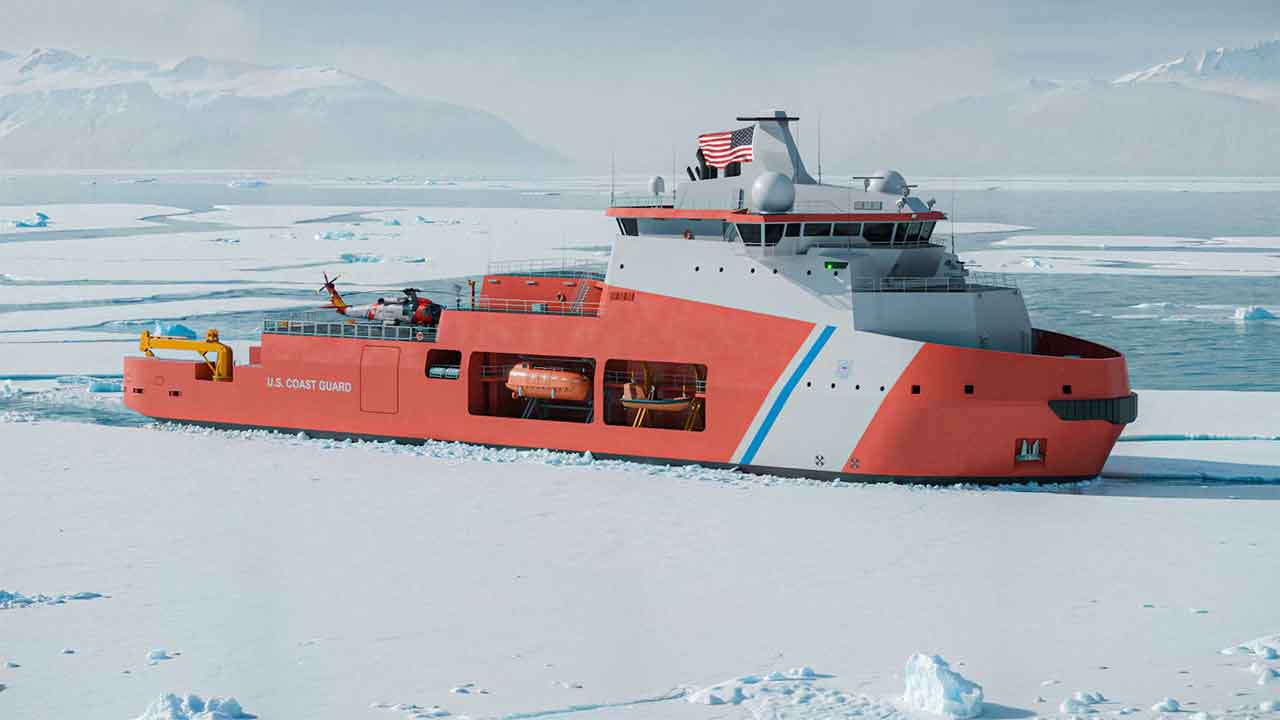
The United States Coast Guard announced this week the completion of all contract awards for the construction of 11 Arctic Security Cutter (ASC) class vessels, fulfilling President Donald Trump’s directive to rapidly expand the United States’ icebreaker fleet.
The announcement marks a historic step in strengthening the American presence in the Arctic, a region increasingly strategic in geopolitical and economic terms.
The most recent contract authorizes the construction of up to five additional units, adding to previous awards published on December 29, 2025, and completing the initial presidential order. Together, the 11 icebreakers will form the backbone of a revitalized fleet focused on protecting U.S. sovereignty and projecting maritime power in the northern hemisphere.
“America has been an Arctic nation for more than 150 years, and we are finally acting like it under President Trump,” said Secretary of Homeland Security Kristi Noem in an official statement. “Equipping the Coast Guard with Arctic Security Cutters will help reaffirm American maritime dominance in the Arctic.” According to her, expanding icebreaking capabilities is “crucial to our security and prosperity.”
+ Ukrainian military intelligence drones neutralize Russian Podlet, Nebo-U and Tor-M2DT radars
International and Domestic Production
Davie Defense, Inc. has been contracted to build two of the new icebreakers at the Helsinki Shipyard in Finland, while three additional units will be produced at shipyards in the United States. Delivery of the first vessel is expected in early 2028.
The ships will serve to defend American sovereignty in the Arctic, protect strategic maritime routes, ensure access to energy and mineral resources, and counter what the Coast Guard described as “malign” foreign influences. A robust fleet, according to the service, will enable control and defense of Alaska’s borders, facilitate maritime trade vital to the economy, and respond to crises and contingencies in the region.
Admiral Kevin E. Lunday, Commandant of the Coast Guard, stated that accelerating icebreaker construction also strengthens the U.S. naval industrial base and secures American leadership as a maritime power in the Arctic.
Diplomatic Controversy with Greenland
The announcement comes amid a sensitive diplomatic dispute involving the United States and Greenland, an autonomous territory within the Kingdom of Denmark. Since 2025, the Trump administration has reiterated that the U.S. should have greater influence—or even control—over the Arctic island due to its strategic position. These statements have sparked tensions with European allies and Danish leaders, who insist that Greenland “is not for sale” and that its sovereignty must be respected.
The president’s remarks have included threats of tariffs and suggestions of coercive measures if negotiations do not progress, prompting protests in cities such as Copenhagen and Nuuk and a decline in U.S. favorability among European populations, according to recent surveys.
In response to U.S. pressure, European allies have intensified joint efforts to reinforce Arctic security. The North Atlantic Treaty Organization launched the “Arctic Sentry” mission to coordinate allied operations in the region, aiming to ease tensions generated by the Greenland controversy.
Experts note that U.S. interest in Greenland is tied not only to its strategic location but also to the potential of critical mineral resources that are becoming more accessible as Arctic ice continues to melt.
Strategic Reinforcement in the Arctic
The acquisition of the Arctic Security Cutters is part of the Coast Guard’s modernization program known as Force Design 2028, which seeks to transform the service into a more agile force capable of responding to emerging challenges. The icebreaker fleet is expected to function both as a national security instrument and as a deterrence element in an environment of growing competition among major powers such as Russia and China.
With the first vessel expected to be delivered in 2028, the program is viewed as one of the largest expansions of U.S. polar navigation capability in decades—reinforcing both strategic presence and power projection capacity in one of the world’s most dynamic regions.
Source and images: U.S. Coast Guard | X @USCG. This content was created with the assistance of AI and reviewed by the editorial team.
